Why Does DSL Feel Faster Than Mobile Data — Even When It’s Slower?
Have you ever noticed that your phone or laptop loads websites faster on an ADSL connection compared to a mobile SIM connection — even though the SIM has much higher download speeds?

if yes, you are not alone, That’s a very interesting observation and actually quite common! Even though your sim modem has much higher speed and a lower ping, your ADSL connection feels "snappier" when browsing websites. Let’s see why this can happen.
Why DSL Feels Snappier Than Mobile/Sim internet (Despite Lower Speed)?
1- Consistency and Stability
- DSL connections are typically more stable and consistent because they use a dedicated copper line directly to your ISP.
- Sim (TD-LTE, 4G, 5G wireless) is subject to variable signal quality, interference, and network congestion, which can cause brief delays (jitter), even if the average speed and ping are better.
2- Bufferbloat and Latency Spikes
- Sim modems often suffer from bufferbloat: when the modem/router buffers too much data, it introduces delays in web page loading, especially under load (like background downloads or streaming).
- DSL modems generally have less bufferbloat, leading to faster response times for small requests like web page elements.
3- DNS Resolution
- Sometimes, ISPs provide faster DNS servers for their wired (DSL) customers than for mobile users. Faster DNS means websites start loading more quickly.
- Try using a fast public DNS (like Google 8.8.8.8 or Cloudflare 1.1.1.1) on both modems and compare.
4- NAT and Carrier-Grade NAT
- Mobile networks often use Carrier-Grade NAT (CGNAT), which can introduce extra delay in establishing new connections (like opening a new website).
- DSL connections usually have a direct public IP or simpler NAT, reducing this delay.
5- Congestion and Shared Bandwidth
- Mobile networks are shared among many users in the area. At peak times, your connection may experience micro-delays due to congestion, even if speed tests look good.
- DSL lines are less affected by local congestion.
6- TCP Optimization and MTU Issues
- Some LTE networks have issues with TCP optimization or MTU mismatches, leading to more packet fragmentation and retransmissions, slowing down web browsing.
Summary Table
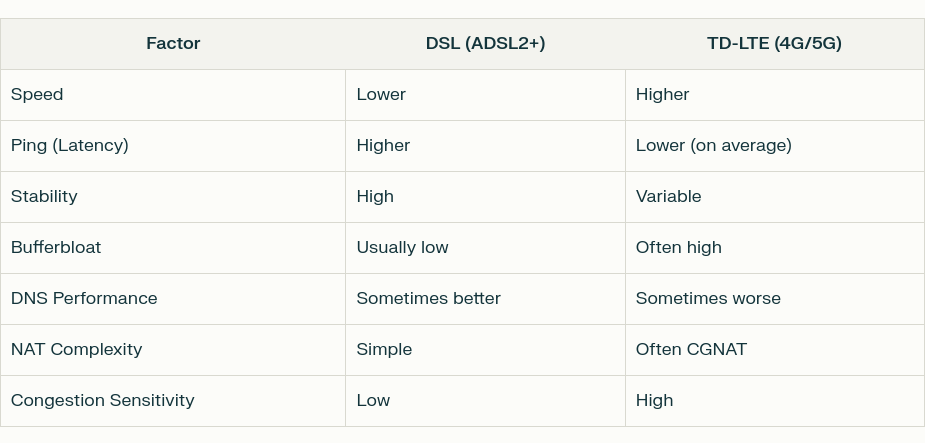
Final Thoughts
- Web browsing feels snappier on DSL because of lower jitter, less bufferbloat, and more consistent connection, even if the raw speed is lower.
- Mobile/ Sim networks are better for downloads, streaming, and large files, but may feel less responsive for small, interactive tasks.
If you want to optimize your Mobile/ Sim network (TD-LTE, 4G, 5G) for web browsing, focus on reducing bufferbloat, using a fast DNS, and minimizing background traffic. If you want more technical details or Linux-based tools to test these effects, just ask!
Fun fact: Many gamers and IT pros around the world still prefer DSL for online gaming and critical tasks, even if mobile internet is faster on paper!
source https://medium.com/@golstar/why-dsl-internet-seems-snappier-than-sim-internet-08cfc9dc2e68?source=rss-8c767f30b98d------2
نظرات
ارسال یک نظر